%20FULL%20COLOUR%20-%20BLUE.svg)
Questions to Ask Your Oncologist: A Guide to Making Informed ALK-Positive Cancer Treatment Decisions

This guide helps you to think about key questions to ask about your care and personalized treatment plan. It’s essential to know your options, share what matters most to you with your healthcare team, and stay actively involved in your decisions.
A survey of patients and oncologists was conducted to determine which aspects of treatment are valued most. The results showed that while both groups valued medication effectiveness, patients prioritized preventing brain metastases even if it meant experiencing more side effects, whereas oncologists focused on extending progression-free survival (1). This difference highlights the importance of open communication to ensure treatment aligns with each person’s priorities.
The content below was developed by Nancee Pronsati, Geoffrey Liu, Todd M. Bauer, Enriqueta Felip, Yasushi Goto, Gerald Green, Mary Grizzard, Michael Hamel, Julien Mazieres, Tony Mok, Stephanie Snow, Benjamin J. Solomon, Jan Stratmann, Ken Culver from a published report, and adapted for this guide by ALK Positive Canada. It has been reviewed by clinicians prior to publication. Please note that this material is provided for educational and informational purposes only. It does not constitute medical advice, diagnosis, or treatment, and should not be used as a substitute for professional medical consultation. Always seek the advice of a physician or other qualified healthcare professional with any questions or concerns regarding your health.
Questions to Guide Your Conversations with Your Oncologist(s) and Healthcare Team
Questions about Side Effects
- Are your side effects affecting your daily activities?
- Have lifestyle changes helped manage your side effects?
- Do you feel you need additional support or medication to manage side effects?
Questions about Priorities
- How have your priorities in your life and in your care needs changed since you started your treatment?
- What new concerns or questions have emerged now that your disease is responding to treatment?
Questions about Support
- Do you feel supported by your healthcare team? What would you like more support with?
- Has peer support been helpful in managing your treatment or overall well-being?
- Could support groups help you more, and if so, how?
Additional Questions
- What advice would you give to other patients who are just starting their treatment journey?
- Are there any foods that should be avoided?
- Have you considered asking about any general diet or supplement recommendations?
- Are there supplements or vitamins you are taking that your healthcare team should know about?
By asking yourself these questions, you can make a list of topics where you may have questions or concerns. Bring these new questions to your appointments, share what matters most to you, and keep revisiting them as your treatment evolves.
What to Expect and How to Manage Side Effects
These steps can help you prepare for possible side effects, watch for changes, manage symptoms early, and check in regularly to make sure you’re feeling your best.
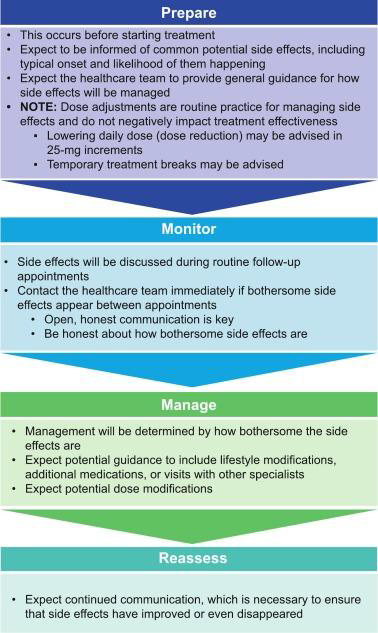
Step 1: Prepare for side effect management
Preparing for side effects should happen before starting treatment.
- Expect to be informed of common potential side effects, including when they are likely to occur and the likelihood of them happening.
- Expect the healthcare team to provide general guidance for how side effects will be managed.
- NOTE: Dose adjustments are routine practice for managing side effects and do not negatively impact treatment effectiveness.
- Lowering daily dose (dose reduction) may be advised in increments.
- Temporary treatment breaks may be advised.
Step 2: Monitor for side effects
Side effects will be discussed during routine follow-up appointments.
- Contact the healthcare team immediately if bothersome side effects appear between appointments.
- Open, honest communication is key.
- Be honest about how bothersome side effects are.
Step 3: Manage side effects
Management will be determined by how bothersome the side effects are.
- Expect potential guidance to include lifestyle modifications, additional medications, or visits with other specialists.
- Expect potential dose modifications.
Step 4: Reassess side effect management plan
Expect continued communication, which is necessary to ensure that side effects have improved or even disappeared.
Summary
This guide is here to help you feel prepared, heard, and supported as you make decisions with your care team. Bring these questions to your appointments, share what matters most to you, and revisit your priorities as treatment evolves.
You can also watch this video with Dr. Geoffrey Liu on TKI side effect management.
Frequently Asked Questions
Why should I report side effects early?
Reporting side effects early helps your healthcare team support you. Many side effects can be managed with the right care, and early reporting may allow you to stay on treatment longer, change/adjust TKI if needed, get the best results, and maintain your quality of life.
Is it safe to adjust my TKI dose if I have side effects?
Yes. Dose adjustments are common in TKI management and do not mean your treatment will be less effective. Watch this video with Dr. Geoffrey Liu on TKI side effect management.
What is a TKI and how does it work?
A TKI (tyrosine kinase inhibitor) is a targeted therapy that blocks specific proteins that help cancer cells grow. By interfering with these proteins, TKIs can slow down or stop cancer growth.
How will I know if the TKI is working?
Your doctor will monitor your response through scans, blood tests, and by tracking symptoms. Feeling better or seeing stable disease on scans are signs that the treatment is working.
Can I take other medications or supplements with my TKI?
Some medications, vitamins or herbal supplements can interact with TKIs. Always tell your healthcare team about everything you take to avoid interactions.
Can I travel or work while on a TKI?
Many patients can continue their normal activities, including work and travel, but it’s important to plan ahead for medication storage, timing and access to medical care if needed.
References
Le H, Coulter J, Cappelleri JC, Lu H, Quaife M, Meginnis K, Fernandez G, Culver K, Vaghela S, Rifi N, Stinchcombe T. Patient and Oncologist Preferences for ALK+ Advanced Non-Small Cell Lung Cancer Tyrosine Kinase Inhibitor Treatments. J Thorac Oncol. 2024;19(10 Suppl):S202. doi:10.1016/j.jtho.2024.09.364